By Navneet, Chief Regulatory Expert at Regbite
FSSAI's long-pending draft amendments to the Advertising and Claims Regulation have been published as a final amendment, and enforcement through 2026 has been noticeably sharper. If you sell a supplement in India, this is the single regulatory development most likely to change what is printed on your pack this year.
Three categories of language are now clearly in scope
Absolute claims
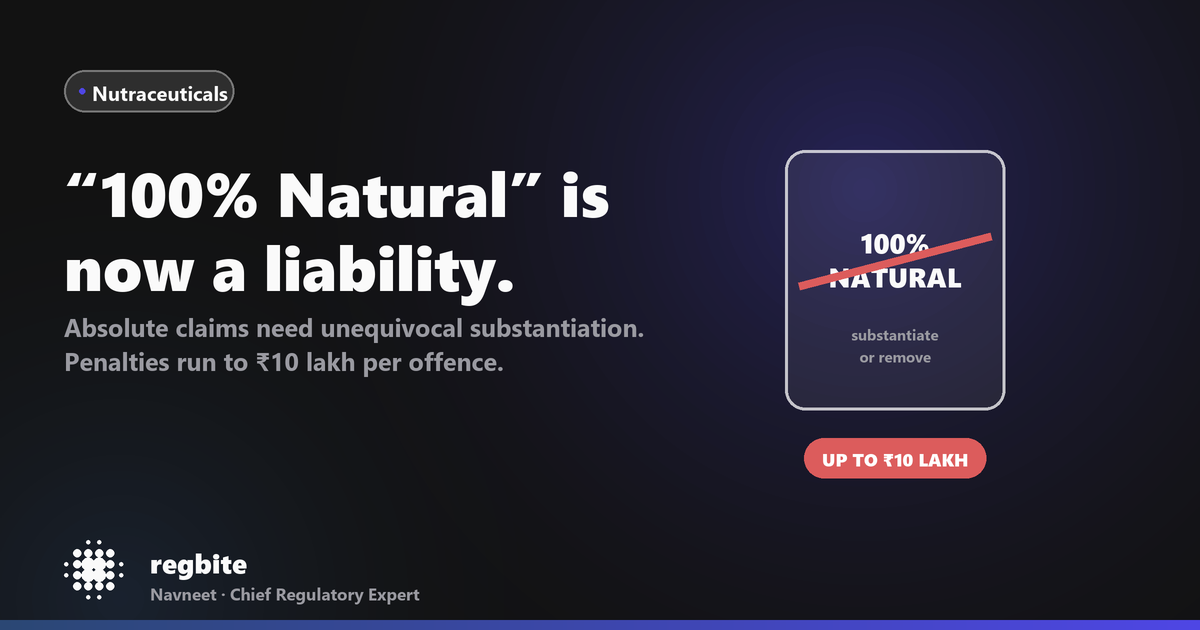
Sweeping superlatives — “100% pure”, “100% natural”, “100% safe” — are not permitted unless they can be unequivocally substantiated. “Unequivocally” is doing real work in that sentence. For most formulated supplements a 100% claim is not substantiable in principle, because the product contains excipients, carriers or a capsule shell.
I audit a lot of labels. “100% natural” on a product containing magnesium stearate and an HPMC capsule is among the most common findings I make — and now among the most expensive.
Medical and disease terminology
Claims that a food can prevent, treat, cure or diagnose a disease, or substitute for medical treatment, are not permitted. The principle has not changed; the enforcement has. The moment your pack makes a disease claim, the regulator can treat your food as an unlicensed drug — which moves the problem out of the FSS Act and into the Drugs and Cosmetics Act.
Unsubstantiated health benefits
This is the one brands most often believe they have covered. A lab report is necessary but not sufficient. A certificate of analysis proves what is in the product. It does not prove that what is in the product produces the benefit you are claiming, in the population you are selling to.
What is expected is validated scientific evidence or peer-reviewed literature supporting that specific claim for your target audience. Evidence for a 500 mg dose does not substantiate a claim on your 100 mg product. Evidence in an elderly cohort does not substantiate a claim aimed at athletes.
The penalty is what changes the arithmetic
Penalties for misleading advertisement run up to ₹10 lakh per offence under Section 53 of the FSS Act. Per offence. For a brand with a dozen SKUs each carrying the same non-compliant phrase across pack and marketplace listings, that adds up uncomfortably fast.
That is what has shifted the risk calculus. A phrase that used to be a mild regulatory annoyance is now a line item.
A three-hour exercise worth doing this week
- Export every claim you make. Pack artwork, website, Amazon and Flipkart titles and bullets, and your ads. One spreadsheet, one row per claim, one column for where it appears.
- Flag every absolute. Search for “100%”, “pure”, “natural”, “safe”, “guaranteed”, “no side effects”, “chemical-free”. Each needs substantiation or removal.
- Flag every disease word. Diabetes, arthritis, cholesterol, blood pressure, immunity from illness, cure, treat, prevent, heal.
- For everything left, name the evidence. If you cannot put a citation in the next column, that claim is unsubstantiated today — regardless of whether it happens to be true.
Regbite's claim validator runs this pass automatically against your label extraction and flags each phrase with the rule code it offends, so you hand your formulation team a list rather than an opinion. But the first version of that audit is a spreadsheet and an afternoon, and I would rather you did it this week than waited for anything.
The brands that get hurt here will not be the ones making outrageous claims. They will be the ones who wrote “100% natural” on a pack in 2019 because everyone did, and never revisited it.
Status as at August 2026. General guidance, not legal advice. Verify the operative amendment text on fssai.gov.in before making label decisions.