FSSAI Just Took “Energy Drink” Off the Label. If You Sell Caffeine, Read This.
By Navneet, Chief Regulatory Expert at Regbite
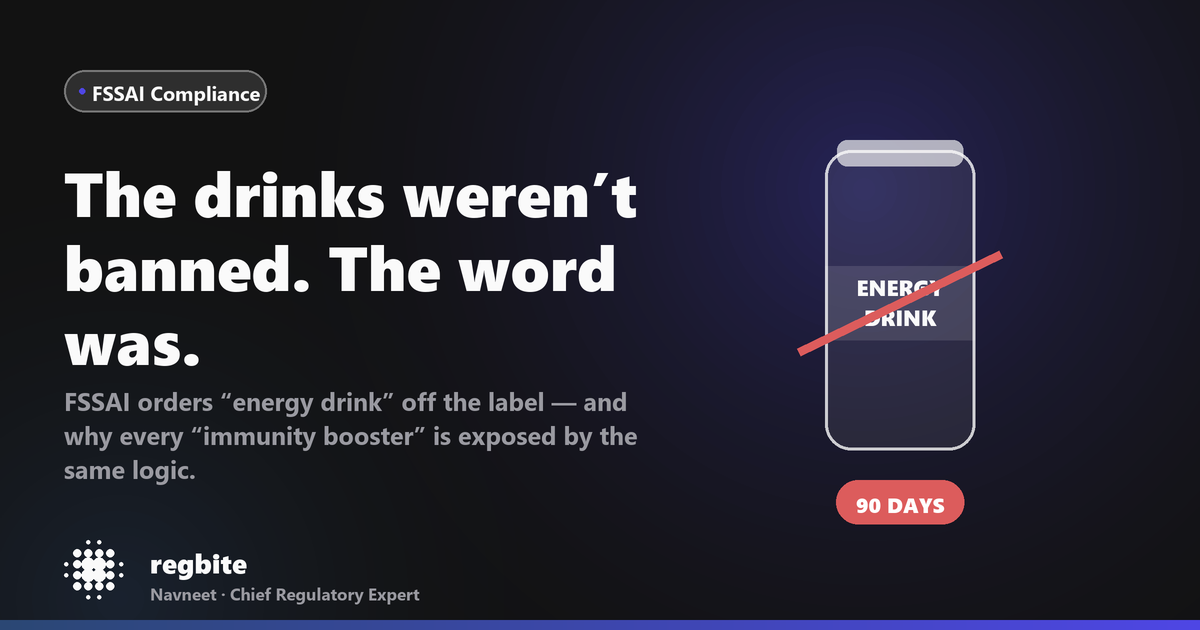
In July 2026, FSSAI told companies selling high-caffeine beverages in India to stop using the words “energy drink” on their packaging. Reporting at the time put the compliance window at 90 days from a meeting between the regulator and industry executives. PepsiCo's Sting, Red Bull, Monster, Reliance's Campa Energy and Hell Energy were all named in coverage of the directive.
Almost every headline I read got the story slightly wrong. So let me be precise about what happened, because the precision is the point.
The drinks were not banned. The description was.
This is not a product withdrawal. Those beverages remain legal to manufacture and sell. What FSSAI objected to was the descriptor and the claims travelling with it.
The regulator's stated reasoning was simple: India has no defined standard for a product category called an “energy drink.” If there is no standard, there is no lawful basis for the term on a label — and a term with no standard behind it becomes, in the regulator's view, a claim. Alongside it, FSSAI objected to claim language about boosting the body or mind, or relieving general weakness.
So the products must be sold under the caffeinated-beverage standards that actually exist, with the caffeine limits and warning requirements attached to that category — rather than under a marketing label that exists only in advertising.
Why this should worry nutraceutical brands, not just beverage brands
I have spent three years building Regbite's rule base, and if you watch FSSAI long enough you stop reading enforcement as a series of unrelated events and start reading it as a pattern. The pattern here is one I see constantly in supplements:
A category name that implies a benefit is treated as a health claim.
Think about how much of the supplement shelf is built on exactly that move. “Immunity booster.” “Fat burner.” “Brain health formula.” “Detox.” “Stamina support.” None of these are defined product categories under the FSS (Health Supplements, Nutraceuticals, Food for Special Dietary Use…) Regulations, 2022. They are marketing descriptors that carry an implied physiological benefit.
The energy drink direction is FSSAI demonstrating that it will act on that construction — that if your category name itself promises an outcome, the regulator can treat the name as an unsubstantiated claim, independent of anything in your ingredient list.
If you sell a product whose category descriptor does the selling, you are exposed to the same reasoning.
What I would do this month if I were you
- Separate your product category from your benefit claim. The category should describe what the product is (a health supplement, a food for special dietary use), not what it promises to do. Move the benefit into a substantiated structure–function claim where it belongs.
- Audit the front of pack, not the back. In almost every enforcement action I have reviewed, the problem was on the principal display panel — the part designed by marketing, not the part reviewed by regulatory.
- Check your e-commerce listings separately. Your Amazon and Flipkart titles are label claims in the regulator's eyes. I regularly find brands whose physical label is clean and whose marketplace title is not.
- Write down the substantiation for every claim before you need it. If you cannot produce the dossier within the response window of a show-cause notice, having the science is the same as not having it.
The 90-day window is the part people underestimate
Ninety days sounds generous until you cost it out. Artwork revision, regulatory sign-off, printer lead times, existing packaging stock, marketplace listing updates across every SKU and every platform. For a brand with thirty SKUs, ninety days is tight. For a brand that finds out on day sixty because nobody was watching the notifications page, it is not enough.
That is the specific problem we built Regbite to remove. Our engine monitors FSSAI publications and maps each change against your actual product portfolio, so the alert you get names your SKU and your ingredient rather than linking a forty-page PDF. Our claim validator flags exactly the class of language at issue here — category descriptors that function as unsubstantiated health claims — before the artwork goes to print, not after a notice arrives.
The brands that will handle this well are not the ones with the best lawyers. They are the ones who knew on day one instead of day sixty.
This article summarises regulatory developments reported in July 2026 and is general guidance, not legal advice. Verify the operative text of any FSSAI direction against the notification on fssai.gov.in before making label decisions.