Old Monk, Royal Challenge, Bagpiper: What the Liquor Crackdown Should Teach Supplement Brands
By Navneet, Chief Regulatory Expert at Regbite
In August 2026, FSSAI prohibited the sale of select variants of some of the most recognisable liquor brands in India — Old Monk, Royal Challenge, Antiquity Blue and Bagpiper among them. The coverage focused on the brand names, which is understandable. I want to focus on the calendar, because the calendar is where the lesson is.
The sequence
- The FSS (Alcoholic Beverages) Standards were amended, with provisions on product standards, composition and quality parameters taking effect 1 January 2026.
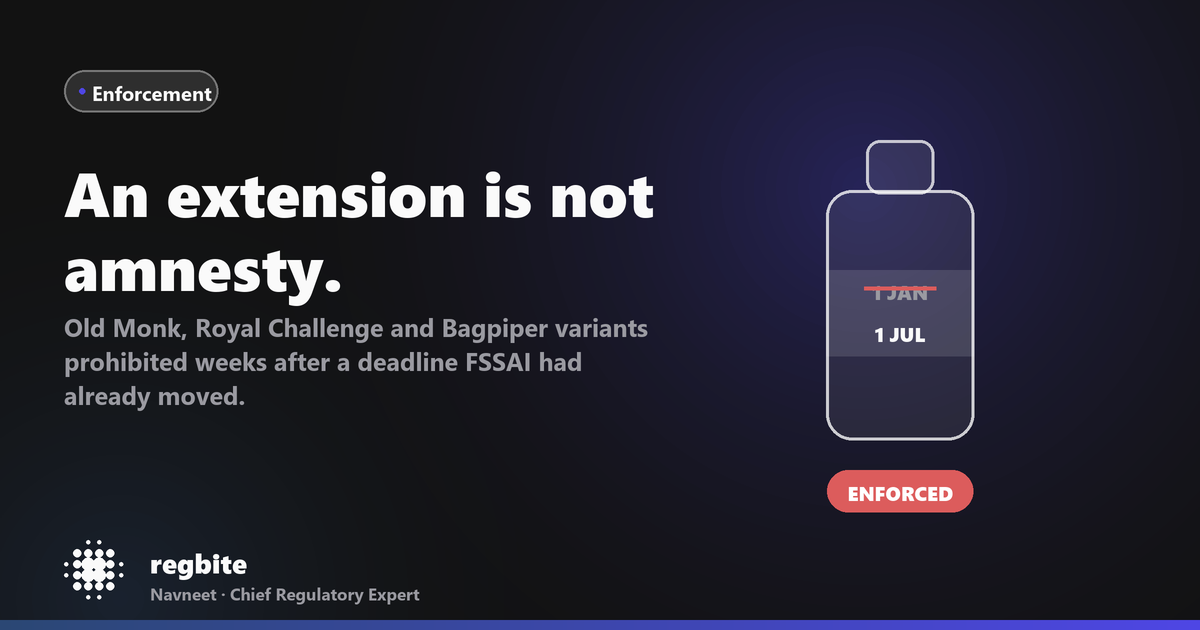
- The labelling provisions were originally to be enforced from 1 January 2026 as well — then pushed to 1 July 2026 by a Direction dated 27 November 2025.
- The extension existed for a practical reason. Alcoholic beverage labels also have to clear state excise registration, which typically happens at the start of the excise year — 1 April or 1 July. Enforcing a January date would have forced the industry to print labels, discard them, reprint and re-register.
- Weeks after the extended deadline passed, enforcement action followed.
An extension is not amnesty. It is a countdown with a new end date.
I have watched this misunderstanding cost brands real money for three years. A deadline gets extended, and somewhere between the notification and the factory floor the message becomes “this got dropped.” It did not get dropped. It got rescheduled — and the regulator now has a documented record that industry asked for more time and received it, which makes the eventual enforcement considerably easier to justify.
If anything, an extension makes the post-deadline period more dangerous, not less. The regulator has already absorbed the argument that compliance was operationally difficult and has already granted relief for it. That argument is spent.
Where nutraceutical brands are sitting on the same trap right now
The supplement industry has its own set of dates that have moved, and I find brands treating them the same way:
- Labelling amendments with transition windows. Every time FSSAI grants a transition period for a new declaration, a portion of the market treats the transition period as optional. It is not — it is the period during which non-compliance is tolerated, and it ends.
- Ingredient limit revisions with reformulation windows. A four-month window to reformulate assumes you started in month one. Most brands start in month three, discover their supplier cannot deliver the revised grade in time, and then need an extension that will not come.
- Category-specific standards that arrive quietly. Composition standards frequently commence before labelling provisions do, exactly as they did here. Brands read the labelling date, miss the composition date, and are non-compliant on formulation while their label is still legal.
That last one is the sharpest edge, and it is precisely what happened in the alcohol timeline above: two different commencement dates inside one amendment.
The operational fix
You do not need a bigger regulatory team. You need a list — of every FSSAI date that applies to your specific SKUs, with the date it commences and the date your artwork actually changes, reviewed monthly.
Most brands do not have that list. They have a consultant who calls once a month and a WhatsApp group where someone occasionally forwards a circular. That is how a rescheduled deadline becomes an enforcement action.
Building and maintaining that list for every customer is essentially what Regbite does. We track commencement dates per provision rather than per notification — because as the alcohol amendment shows, one notification can carry several different dates — and map each one to the SKUs in your portfolio it actually touches. When a deadline moves, the date on your dashboard moves with it, and the reminder still arrives.
The brands that got caught in August were not unaware the rules existed. They were working from a date that had changed.
This article summarises regulatory developments reported between November 2025 and August 2026 and is general guidance, not legal advice. Alcoholic beverages are also governed by state excise law, which is outside FSSAI's remit and outside Regbite's coverage.